Author: Christopher P. Austin , MD on January 15, 2019 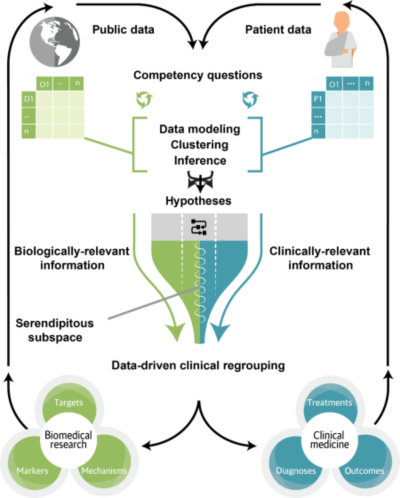
2019 is the 150th anniversary of periodic table, which transformed chemistry by placing it on firm scientific footing. We envision the Biomedical Data Translator doing the same for translational science. A principal stumbling block in translation is the compartmentalized nature of the tremendous amount of data — from biomedical research, disease classifications, health records, clinical trials and adverse event reports — across diseases and disciplines. These silos impede discovery of commonalities across diseases, and the distinct languages that each discipline uses impedes the cross-discipline understanding that is required for efficient translation from basic to clinical to public health science. The Translator is designed to bridge the current symptom-based diagnosis of disease with research-based molecular and cellular characterizations through an informatics platform that enables interrogation of relationships across the full spectrum of data types, from disease names, clinical signs and symptoms, to organ and cell pathology, genomics, and drug effects.
Two articles in Clinical and Translational Science describe the conception and design and early utility of the Biomedical Data Translator. The National Center for Advancing Translational Sciences (NCATS) is currently funding a feasibility assessment phase of Translator, focused on identifying data integration and inclusion barriers, and exploring inferential or predictive models that would provide new insights into biology, health, and disease. Given the broad and ambitious nature of the project, we assumed that we did not understand all requirements or needed capabilities when we started. The platform is being built in an agile way with frequent modifications driven by data from “pressure testing” using research questions that have been difficult to address by other means. Operationally, NCATS supports Translator through a flexible research authority called Other Transactions (OT) within the Center’s Cures Acceleration Network (CAN). The flexibility of OT to rapidly expand, contract, add, discontinue, or modify activities based on data as the program is built has changed the usual ways that we, as funders, interact with research teams and they interact with each other.
This, too, was an experiment. Could we entice over a dozen high-performing research teams from very diverse backgrounds to become fully miscible with each other and with us in order to make the Translator vision possible? At the end of the feasibility phase, NCATS will assess whether the scientific, operational, and cultural experiments have been successful enough to warrant ramping-up to build a fully functional Translator that finds and connects existing data, provides previously unknown insights into diseases and possible treatments, and is able to make inferences and predictions even when data are missing. Given that the scientific and cultural accomplishments of the team described in these commentaries by the Biomedical Data Translator Consortium have outpaced even my most optimistic projections, I am encouraged that the Translator vision is indeed achievable. When fully built, the Translator, similar to the periodic table years before, will advance translational science by integrating our field’s knowledge into a relational format, and thus deconstructing the translational tower of Babel.
Image by The Biomedical Data Translator Consortium. Clin. Trans. Sci., https://ascpt.onlinelibrary.wiley.com/doi/10.1111/cts.12591, is licensed under CC BY-NC 4.0. ©2018 The authors.

The comment feature is locked by administrator.