Author: Sarah M. Robertson, PharmD on August 22, 2018 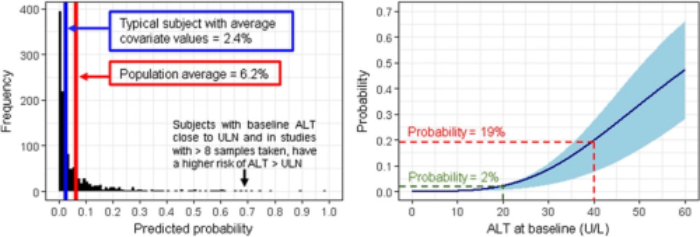
A recurring challenge in early drug development is the interpretation of emerging safety data from first-in-human (FIH) studies, where typical dose escalation for a novel small molecule follows a 6+2 paradigm, whereby 8 subjects (6 active, 2 placebo) are dosed in each ascending dose cohort. Emerging data is not only used for dose escalation decisions, but may also inform early development decisions. Limited statistical justification or validation of the 6+2 cohort size has been presented in the literature, with opinion and anecdote largely driving the approach. Emerging safety data from 8 subjects per cohort has the potential to mislead investigators and sponsors. How does one interpret an increase in ALT >2xULN if the event is observed in 1 subject out of 8? What if that event is observed in 3 subjects out of 8?
The article from Clayton et al. recently published in CTS, “How Often Do Safety Signals Occur by Chance in First-in-Human Trial,” provides a framework to potentially address that question. The authors retrospectively reviewed a large repository of placebo-controlled healthy volunteer data to understand the frequency of random safety signals, such as liver enzyme elevation or heart rate increase.
The authors then demonstrate how a predictive model can be used to estimate the probability of observing an event in a placebo-treated subject. Understanding the likelihood of observing a chance safety signal in FIH studies with a limited placebo group is incredibly valuable. Just as valuable, however, is the example of a drug sponsor using innovative modeling approaches and leveraging their extensive clinical data to make smarter development decisions.
Image by Clayton, et al. Clin. Trans. Sci., doi.org/10.1111/cts.12558, is licensed under CC BY-NC 4.0. ©2018 The authors.

The comment feature is locked by administrator.