Author: Linda Jeng, MD, PhD, and Jeff Siegel, MD on May 12, 2026 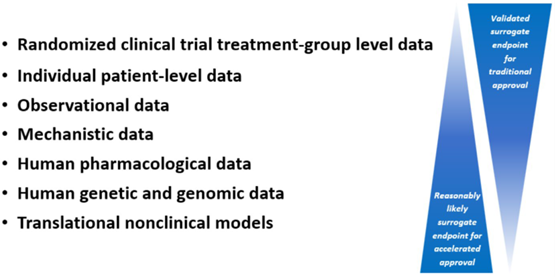
Figure. Potential sources of data to support a surrogate endpoint.
In the recent Clinical and Translational Science perspective piece authored by Drs. Linda Jeng and Jeffrey Siegel, they illuminate a critical pathway for bringing treatments to patients faster: the use of surrogate endpoints in drug approval decisions. The authors conclude that when rigorously validated, biomarkers serving as surrogate endpoints can significantly expedite drug development for serious diseases with unmet medical needs, particularly rare conditions where traditional clinical trials measuring how patients feel, function, or survive may take years or even decades to complete. In situations like that, accelerated approval using a surrogate endpoint that is "reasonably likely" to predict clinical benefit may be appropriate. Determining when a surrogate endpoint is reasonably likely to predict clinical benefit requires careful scientific judgment, drawing on multiple evidence sources including data from clinical trials, observational studies, disease pathophysiology and mechanism, epidemiologic studies, pharmacologic studies, human genetics and genomics, and translational nonclinical models. The paper demonstrates through compelling case examples—from ALS to rare bone disorders—that convergent evidence from diverse sources can establish confidence in surrogate markers when traditional clinical trial data are unavailable.
For patients and clinicians, these conclusions translate into tangible hope and faster access to potentially life-saving therapies. The accelerated approval pathway using reasonably likely surrogate endpoints means that patients with conditions like SOD1-ALS or Fibrodysplasia Ossificans Progressiva may not have to wait for lengthy trials measuring survival or disability progression before accessing promising treatments. If successful, clinicians could offer novel therapies years earlier, with the understanding that post-marketing confirmatory trials are necessary to verify the predicted clinical benefits. This approach represents a carefully balanced regulatory framework that acknowledges the urgency of unmet medical needs while maintaining scientific rigor. For the rare disease community, where small patient populations make traditional trial designs impractical, the thoughtful application of surrogate endpoints offers a scientifically sound path forward that respects both the need for evidence-based medicine and the imperative to act swiftly when patients have no other options.

The comment feature is locked by administrator.