Author: Wenjie Wang, PhD, and Da Xu, PhD on March 17, 2026 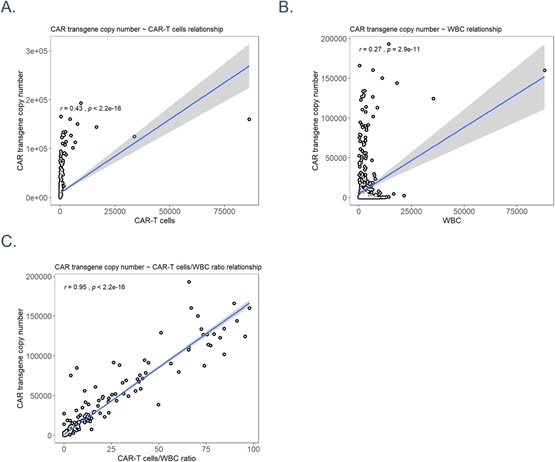
Chimeric antigen receptor (CAR)-T cell therapy has achieved remarkable success in the treatment of hematological malignancies and demonstrated promising antitumor activity in solid tumors. Accurate characterization of CAR-T cell kinetics is essential for understanding the efficacy and safety of these living therapeutics. Flow cytometry and quantitative polymerase chain reaction (qPCR) are the two most widely utilized methods for quantifying CAR-T cells, each with distinct advantages and limitations. Our study integrated and analyzed data from four Phase I clinical trials offering critical insights into the interpretation and application of these two analytical methods.
A pivotal finding of our study is that while marketed CAR-T products (tisagenlecleucel and lisocabtagene maraleucel) show a strong correlation between CAR-T cells and CAR copy number, this relationship varies significantly across our internal projects. CAR-T cells/WBC ratio shows a better correlation with CAR copy number than CAR-T cells in all our projects. This indicates that qPCR reflects the proportion in circulation rather than absolute counts. In contrast, flow cytometry directly quantifies pharmacologically active CAR-T cells and demonstrates a wider dynamic range, especially during peak expansion. Notably, flow cytometry-measured CAR-T cells showed stronger correlations with key cytokines (IL-6, IFN-γ et al.) that are important biomarkers for predicting toxicities like cytokine release syndrome. These results highlight how flow cytometry enables more accurate early pharmacokinetic monitoring and improves exposure-safety assessment.
For clinicians and clinical pharmacologists, our research emphasizes the importance of method selection in interpreting the pharmacokinetic data of CAR-T products. Specifically, flow cytometry better captures early expansion dynamics and can aid in toxicity monitoring and management. Integration of qPCR (assessing long-term persistence) and flow cytometry (quantifying early expansion) offers a complementary bioanalytical strategy, enabling improved characterization of CAR-T cell kinetics and exposure-response analysis.

The comment feature is locked by administrator.