Author: Philippe Pinton, MD, PhD on April 03, 2026 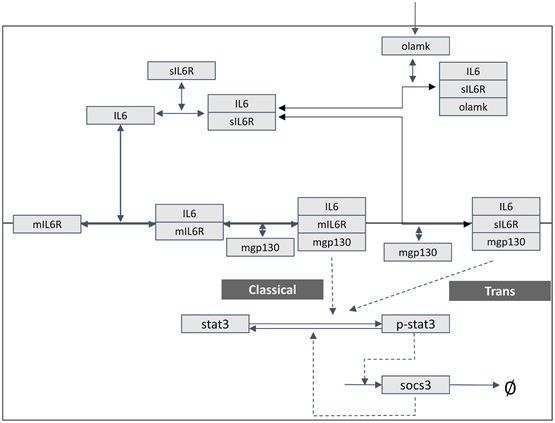
Interleukin‑6 (IL‑6) plays a central role in ulcerative colitis (UC) by activating two distinct pathways: classic signaling, mediated by the membrane‑bound IL‑6 receptor and supporting homeostasis and tissue repair, and trans‑signaling, mediated by the soluble IL‑6 receptor and driving pro‑inflammatory activity. Preserving this distinction is essential when evaluating IL‑6–targeted therapies.
Our multi‑scale mechanistic model of UC provides quantitative evidence that selective inhibition of IL‑6 trans‑signaling can suppress inflammation while preserving the regenerative functions associated with classic signaling. By simulating virtual patient cohorts and treatment scenarios, we show that therapies blocking both pathways may inadvertently impair mucosal healing, whereas trans‑specific inhibition maintains IL‑6–mediated repair mechanisms. This is consistent with the article’s finding that global IL‑6 suppression can negatively affect IL‑6‑induced regeneration activity, whereas selective inhibition is less likely to have this effect.
These results align with emerging clinical data and support the development of trans‑signaling–selective agents such as olamkicept, which neutralizes IL‑6 trans‑signaling without disrupting classic signaling.
For clinicians, distinguishing between classic and trans‑IL‑6 signaling is increasingly important when considering future therapeutic options. Selective trans‑signaling inhibition may offer a more favorable balance between efficacy and safety, reducing inflammation without compromising tissue repair. For patients, this approach could translate into faster recovery, improved outcomes, and fewer adverse effects linked to impaired regeneration.
In real‑world practice, mechanistic modeling can enable biomarker selection and support personalized treatment strategies by predicting how patients may respond to selective versus global IL‑6 pathway inhibition. As computational models become more integrated into translational research, they provide powerful tools for anticipating patient responses and optimizing therapeutic regimens before clinical implementation. This work also opens the door to digital twins and in silico clinical trials, accelerating drug development and improving patient access to innovative therapies.

The comment feature is locked by administrator.