Author: Piet van der Graaf, PhD, PharmD on June 02, 2016 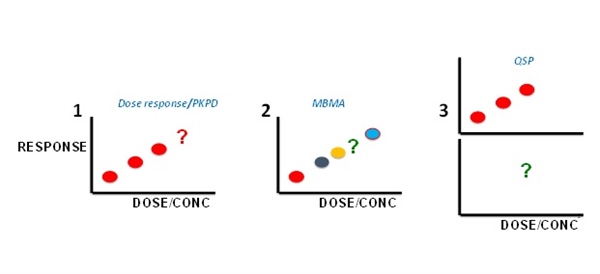
I attended the workshop “Extrapolation of Efficacy and Safety in Medicine Development Across Age Groups” at the European Medicines Agency in London two weeks ago and was asked to give my perspective on modeling and simulation principles and tools for extrapolation. To prepare for my talk, I looked up the definition of “extrapolation” in Wikipedia and found that there are actually three.
The first definition was the one I expected to find: “In mathematics, extrapolation is the process of estimating, beyond the original observation range, the value of a variable on the basis of its relationship with another variable. It is similar to interpolation, which produces estimates between known observations, but extrapolation is subject to greater uncertainty and a higher risk of producing meaningless results”.
However, Wikipedia gives two additional definitions, namely that “Extrapolation may also mean extension of a method, assuming similar methods will be applicable” and “Extrapolation may also apply to human experience to project, extend, or expand known experience into an area not known or previously experienced”.
Translating this to our discipline, I could see the link with different methodological approaches for extrapolating clinical pharmacology. The first definition seems to describe dose/exposure response (PKPD) modeling where, for example, the aim is to predict a dose outside the range studied. The second captures model-based meta-analysis where information from other compounds can be used to predict efficacy or safety of an untested dose of a novel agent with the same mechanism-of-action using statistical techniques. Finally, the third definition seems to relate to quantitative systems pharmacology (QSP), where (in contrast to the previous two types) the extrapolation involves scaling from one biological system to another, for example from an adult to a pediatric patient or from a preclinical model to man. There is an important role for each approach, but the confidence in the extrapolation method very much depends on the question. Pharmaco-statistical approaches can work well for within-system extrapolation (i.e. predicting a higher-than-tested dose), but can be fundamentally flawed in the context of between-system extrapolation (i.e. predicting pediatric PKPD from adults). Application of QSP in pediatrics is still in its infancy and currently largely focused on physiologically-based pharmacokinetic models (see examples in the PSP Pediatrics Virtual Issue and case studies in the recent White Paper “Good Practices in Model-Informed Drug Discovery and Development: Practice, Application, and Documentation”. Has the time come for a more system-oriented approach to predict efficacy and safety in pediatrics?

The comment feature is locked by administrator.