Author: Franz Koenig, PhD, Sophie Brunner-Ziegler, PhD, Fabian Eibensteiner, MD, Eva-Maria Zebedin, PhD on September 08, 2026 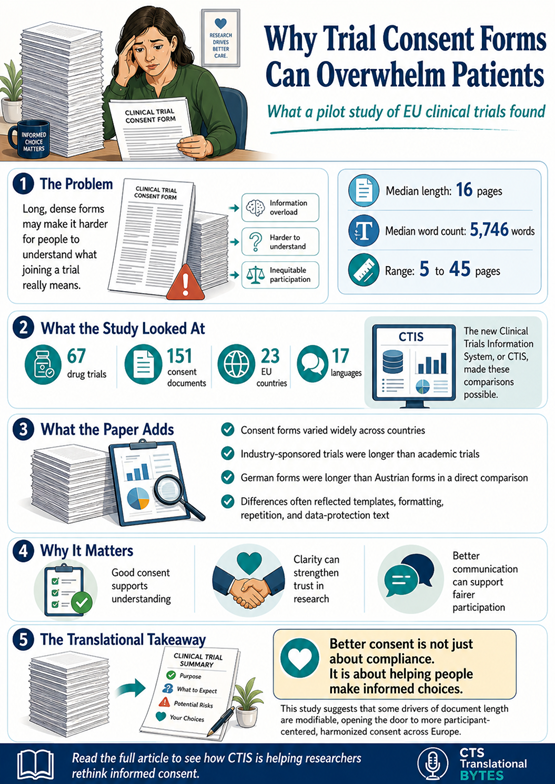
Subject information sheets (SIS)/consent documents are not just administrative paperwork, they decisively shape how people enter and experience clinical research.
One: SIS/consent documents are a front door to clinical research. For many participants, the information sheet and consent form are the first detailed explanation of what participating in a clinical trial will involve. If that front door is crowded with dense language, repeated sections, and long legal wording, people may struggle to find the information they need most. This study found that European clinical trial consent documents were often quite lengthy, with a median of 16 pages and nearly 6,000 words. Such overly long documents are a source of risk, as they might fail to convey essential information clearly enough.
Two: Differences that were identified may reveal opportunities for improvement. The authors used publicly available European trial documents to compare SIS/consent forms across countries, sponsors, and trials. They found substantial differences, including longer documents in industry-sponsored trials compared with those sponsored by academia, and longer German documents compared with Austrian ones in a smaller German-language comparison. Importantly, these differences did not appear to be explained simply by more core content. Instead, structure, repetition, and template requirements may play a major role.
Three: Better consent is part of better research. Translational science and clinical research depend on people agreeing to participate in trials with a clear understanding of what that means. A consent document should not aim to explain the relevant content in fewer words at any cost. However, it should facilitate, rather than impede, the consent process and the associated communication. This paper is a reminder that improving clinical trials is not only about better molecules, endpoints, or statistical methods. It is also about improving communication with the participants, without whom the research would not be possible.
Disclaimer: This blog post and accompanying visual materials were developed with assistance from ChatGPT. ChatGPT was used to support drafting, editing, and visual concept development. The authors maintained full editorial control and responsibility for the final content.

The comment feature is locked by administrator.