Author: John A. Wagner, MD, PhD on February 03, 2026 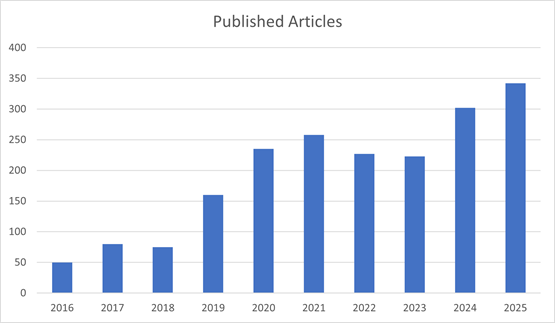
At Clinical and Translational Science (CTS), we hope you had a restorative holiday season, and wish you a clear, grounded start to a successful 2026.
2025 by the numbers:
- 2024 journal impact factor (IF) (Clarivate): 2.8
- 2024 CiteScore (Scopus): 6.6
- 1,090,000 downloads
- 342 articles e-published
- Articles from 30 countries
- 32 days average duration from submission to first decision
2025 was a complex and challenging year for science (and the world), but for CTS it was auspicious. 2025 by the numbers was a good one. One of our key objectives continued to be becoming a beacon for the field of translational science. Growth of CTS since we relaunched as an ASCPT journal in 2016 is displayed in the graph above, which bodes well for continued successful future of the Journal.
AI is everywhere in science and scientific publishing, reflected in CTS with a 2025 Artificial Intelligence/Machine Learning (AI/ML) special collection. CTS special collections are themed groupings of papers of topical interest to translational science. Open Access special collections at CTS have rolling submission and publication. Articles can be published when they are ready instead of waiting for a special issue to be published. We completed the Diversity, Equity, and Inclusion special collection and launched the Biomarkers and Quantitative Medicine special collections in 2025 as well. Stay tuned for a call-for-papers for a new Precision Medicine special collection, celebrating the 10-year anniversary of CTS with ASCPT. Another exciting, new journal feature is a rapidly growing series of highly translational articles, mechanism of action (MOA) mini-reviews. This ever-expanding series of MOA mini-reviews provides a concise, readable understanding of new therapeutics and boasts a current library of 16 mini-reviews. CTS also launched a Paper of the Month feature designed to feature a noteworthy article on a monthly basis.
In the spirit of a 2025 review, we wanted to celebrate our most impactful contributions. Looking forward to the next IF, the 5 most highly cited papers* in 2025 are listed below. All 5 currently have more citations than the top cited paper last year, encouraging for the anticipated 2025 IF, which should be available in June.
IF is just one way to measure journal influence. Another important metric of impact is downloads, which also demonstrated strong results in 2025. Downloads are an obvious impact metric that measures how often journal readers take the time to download an article. CTS downloads have shown impressive growth since we relaunched as an ASCPT journal in 2016. Downloads also demonstrate the value of an open access journal, since there is no paywall to prospective readers. The 2025 download winners demonstrate the strong impact of the MOA mini-reviews – 2 of the top 5 are MOA mini-reviews, which underlines the utility of these articles. The 5 most downloaded CTS articles in 2025** were:
- Precision Medicine, AI, and the Future of Personalized Health Care by Johnson et al., 19,532 downloads
- Practical guide to SHAP analysis: Explaining supervised machine learning model predictions in drug development by Ponce‐Bobadilla et al., 12,937 downloads
- Dupilumab: Mechanism of action, clinical, and translational science by McCann et al., 8,037 downloads
- Upadacitinib: Mechanism of action, clinical, and translational science Mohamed et al., 7,686 downloads
- PK/PD analysis of trazodone and gabapentin in neuropathic pain rodent models: Translational PKPD modeling from nonclinical to clinical development by Oggianu et al., 7,026 downloads
CTS prides itself on democratizing science and fighting misinformation with evidence-based social media. In our increasingly social media-connected world, another measure of journal influence is the Altmetric score, which is a measure of the global, public attention articles garner, including through news outlets and social media. Unfortunately, the Altmetric score does not include LinkedIn posts, a major social media venue for ASCPT members. The 5 highest 2025 Altmetric scores*** in CTS were:
Thanks to all the CTS authors and readers, ASCPT membership, and the many folks who make the Journal work – including editors, peer reviewers, as well as ASCPT and Wiley staff. CTS had another successful, impactful year on the journey to becoming a beacon of translational science. The Journal owes its success to you. We, at CTS, appreciate you!
Do you have the next IF, download, or Altmetric winner, new terrific MOA mini-review, or contribution to a special collection? Submit to CTS and find out. Tune into one of our special collections or submit to one of our new collections this year. Are you curious about the top cited, downloaded, or Altmetric-winning papers? Read them today, and join us in 2026 to help drive our vision for translational science with your submissions.
* Preliminary 2025 impact factor “in-window” citations (i.e., those from articles that will count toward the next IF).
** Number of downloads in 2025 for any article published in CTS.
*** Altmetrics calculated through December 31, 2025, associated with any article published in 2025 as reported on January 26, 2026.

The comment feature is locked by administrator.