Author: Jannik Rousel, PhD on October 21, 2026 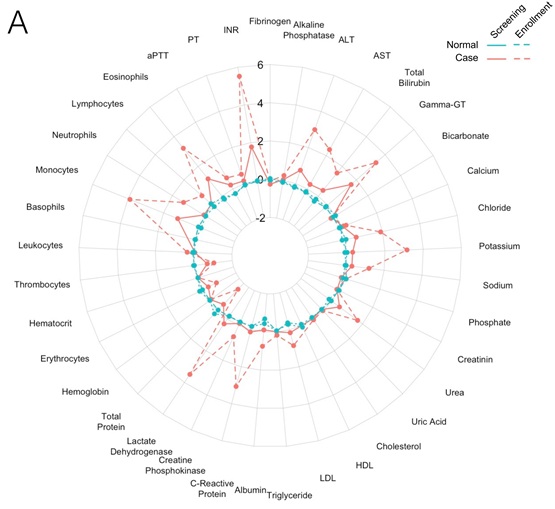
Laboratory results represent essential tools for monitoring safety during clinical trial conduct and reassure many investigators as long as they remain within the reference intervals (RIs). These intervals reflect the ‘normal range’ as determined from a set of healthy participants and are usually applied to patient populations in the detection, diagnosis, and treatment of diseases. For clinical trials in healthy volunteers, these reference intervals are also commonly used as a benchmark for determining whether prospective participants can be truly considered healthy and, after passing the medical screening, whether they remain healthy during a trial. Reference interval excursions can therefore be interpreted as indicators of (potential) harm of the investigative drug to participants, warranting additional actions or follow-up. However, reference interval excursions are not always true indicators of harm.
In this study, Rousel et al. performed a retrospective analysis on laboratory results from healthy participants in the placebo arm of 88 early-phase clinical trials. By providing data on common excursions in placebo-randomized participants, investigators are provided with guidance for the interpretation of aberrant laboratory results, which facilitates trial continuity accordingly.
It was observed that participants with reference interval excursions at the start of a trial already showed more extreme results at the medical screening. This was supported by the finding that more extreme values are consistently observed within participants during trial participation, indicating that an individual predisposition exists towards more extreme values, challenging the applicability of RIs in a longitudinal setting. Indeed, reference interval excursions occurred regularly throughout almost all measured parameters in participants receiving placebo, including aspartate and alanine transaminases. Both the frequency and severity of reference interval excursions were parameter specific but generally within 0.7–1.3 times the predefined reference interval.
Based on the observations in placebo-randomized participants, excursions in laboratory results are not necessarily indicators of drug-induced adverse effects by themselves. During trial conduct, they should always be contextualized with the participant’s clinical presentation and laboratory results from other participants in the same cohort before conclusions are drawn.

The comment feature is locked by administrator.